- Briefcase Coach's Career Briefs: Job Search Newsletter
- Posts
- Career Briefs: Bonuses, Buyouts & Big Moves
Career Briefs: Bonuses, Buyouts & Big Moves
In this issue: What to do if your role was duplicated in a merger, who is getting big bonuses, working with recruiters... and much more!

Sarah Johnston
January 14, 2026

Dear Reader:
Many of you reading this are considering launching a Q1 job search. Maybe you’re waiting for a bonus payout in February, or perhaps you’ve quietly decided that this is the year you make a move.
If that’s you, I want to offer a piece of advice that may feel counterintuitive—but is far more important than almost anything else.
Yes, you need a strong resume and clear, compelling branding materials (and of course, that’s work I can help with). But the single most important driver of a successful executive job search is this: having more conversations with decision-makers.
Too many smart, capable executives make the mistake of putting their entire job search in the hands of one person. The thinking often goes: “If I can just find the right recruiter, they’ll take it from here.” Unfortunately, that’s not how it works.
Recruiters are not real estate agents.
They’re not out there “shopping” for you or trying to place you in the perfect role in the right neighborhood.

Recruiters work for companies, not candidates—their incentives are tied to very specific searches at very specific moments in time. That’s why relying on a single recruiter (or even two) dramatically limits your exposure.
Instead, a successful job search is built on the volume and variety of relationships. I typically recommend that executives in active search mode identify 10–25 recruiters who specialize in their function or industry and stay in consistent, proactive communication with them. That doesn’t mean pestering—it means staying visible, relevant, and top of mind.
Momentum matters. The opportunities that move the needle most often come not from a single “perfect” connection, but from multiple conversations, overlapping networks, and being known by more people than you think you need.
Your goal isn’t to be represented.
Your goal is to be remembered.
I recently ran a LinkedIn survey with over 500 responses, asking executives what they would do differently if they could redo their last job search. 27% said the single most impactful change would have been having more recruiter relationships. The data reinforces what I see every day: more conversations with the right people = more opportunities.
If you’re considering a move this year, don’t wait for the “perfect” connection to fall into your lap. Start building those relationships now, and make sure you’re the candidate people remember.

As always, I am rooting for you,
Sarah
Table of Contents
Your Role Was Duplicated In A Merger—Now What?

I’m seeing the same scenario show up again and again at the VP and executive level: a merger happens, performance is strong, and suddenly the acquiring company already has someone in your role.
When that happens, panic is understandable—but it’s rarely the right move.
I put together a clear 30-60-90-day plan for how to stabilize, protect your leverage, and create real options for yourself before decisions get made for you.
If you’re navigating role overlap after a merger (or sense one coming), this will help you think—and act—strategically.
Read more here: What to do when your role is duplicated in a merger
$$$ Bonus Season
Bonus season is around the corner. There’s a long-standing joke among resume writers that even the most ambitious job seekers suddenly develop a strong commitment to “waiting until February.”
I did a survey on LinkedIn this week and found that — of my readers who are expecting a bonus — more than 75% expected bonuses larger than the national average of $1,786.
Who’s getting the big checks? LinkedIn lets me see how people voted, and those reporting bonuses of $50K or more hold titles like VP of Sales, Head of Corporate Development, and CEO. The majority have responsibilities in revenue, sales, or business development.
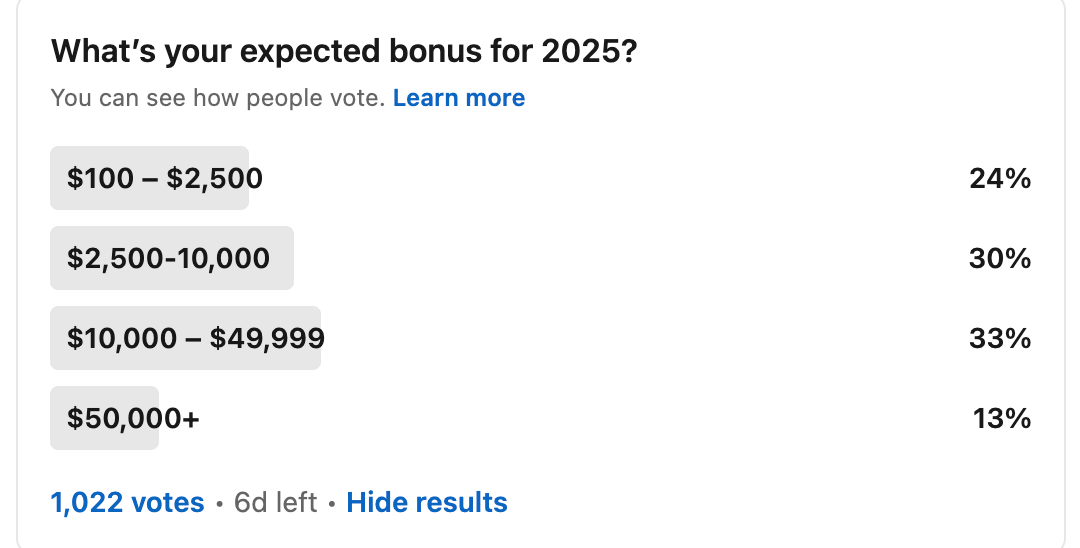
This aligns with Deloitte’s Executive Compensation Survey, which found that 63% of companies limit annual incentives to directors and above—roles with greater influence over strategy and company-wide financial outcomes. Non-director roles are more often rewarded through base pay and smaller, performance-based incentives.
If you’re curious to benchmark your peers’ bonuses, the SEC requires public companies to disclose detailed executive compensation information in annual proxy statements, including pay amounts, types, and how compensation decisions align with company performance. These filings offer valuable insight into a company’s executive pay philosophy, structure, and incentives. To find SEC filings, you’ll go to its database known commonly as EDGAR.
Nearly 80% of People Feel Unprepared to Job Search
LinkedIn just released a new report showing how dramatically the job search has evolved over the past two years—most notably, the rapid adoption of AI on both sides of the hiring process. According to the report, 93% of recruiters say they plan to increase their use of AI in 2026, while 81% of job seekers either already use—or plan to use—AI in their search.
The unintended consequence? ATS chaos.
LinkedIn reports that the number of job applicants has doubled since 2022, yet recruiters are more overwhelmed than ever. AI has made it easier to apply, customize, and mass-submit applications, flooding systems with volume—but not necessarily with better-qualified candidates. As a result, strong candidates are getting buried, recruiters are drowning in noise, and the gap between “applied” and “actually considered” continues to widen.
💼 Brief Takeaway: Warm introductions and targeted emails will stand out in this market.
Read the report here: LinkedIn Research
Disposition Data— Why This Should Concern You
Indeed has quietly launched Disposition Sync, a new feature that could fundamentally reshape hiring—and how candidates are evaluated. Unlike a typical job board update or AI tool, Disposition Sync automatically pulls detailed post-application data from employers’ applicant tracking systems (ATS) and feeds it back to Indeed. This includes whether you were screened out, interviewed, offered a role, or rejected—often with timestamps, application sources, notes, and even demographic information. Historically, this information stayed inside a single company, but now Indeed can track patterns across thousands of employers, effectively transforming itself from a job board into a labor market intelligence platform.
For job seekers, this could have big implications. Your past rejections could influence how you’re ranked or matched elsewhere, without your knowledge or ability to correct the record. Biases from human decision-making can become encoded in algorithms, disproportionately affecting career switchers and those with non-linear paths. Your resume and LinkedIn profile tell one story—your disposition history tells another, and the algorithm may trust the latter more. In short, hiring is moving from a company-by-company evaluation to market-wide pattern scoring. If you’re job searching—or advising others—understanding this system, and strategically managing visibility, has never been more important.
Additional Reading: See my LinkedIn post on this topic and the 100+ global comments. You can also read Indeed’s press release.
College Pedigree Matters… Again.
“We hire people, not degrees.” 🚫 This language was recently removed from McKinsey’s website as they double down on their recruitment efforts at top colleges.
Early in my career, I served as the lead campus recruiter for a large, privately held company in the Southeast. I managed both the campus recruiting budget and my schedule, which limited me to visiting about 8–10 college campuses per year to build our early-career talent pipeline. When selecting which schools to visit, I considered factors such as our alumni presence, the strength of our company’s brand in the surrounding markets, and the quality of degree programs aligned with our hiring needs.
According to Lindsay Ellis’s recent Wall Street Journal article (paywall removed), “Talent is everywhere,” hiring appears to be falling out of favor, for several reasons cited by entry-level recruiters. For one, it’s costly—setting up candidate meetings and sending recruiters to campuses across the country requires significant investment.
“Most companies now recruit only at up to 30 American colleges out of about 4,000, starting with top-ranked schools and then looking at local universities, said William Chichester, III, who has spent years directing entry-level recruiting at companies including Target and Peloton.”
If you fall outside of those two categories? “God help you,” he added.
US Talent Shortage— Internships
Nearly 90% of Briefs readers are senior leaders—but many of you also have teenage or college-age kids, or will in the years ahead. The current U.S. talent development deficit is a signal we should all be watching closely:
Brandon Busteed, CEO of Edconic, highlighted this challenge in his latest Forbes article, underscoring a harsh reality: there are not enough internships for college students, creating a huge gap between overwhelming student demand (8.2 million seeking vs. 3.6 million getting one)
Having led campus recruiting—and having started my own career as an intern—I know firsthand how critical internships are for giving students real-world experience. I didn’t have “my daddy’s network” to land my first job out of college—I had to earn it. The shrinking availability of internships is deeply concerning, as it limits the next generation’s opportunities to gain the skills and connections they need to succeed. If you have the ability to offer an internship, you could be opening a door that changes a student’s career trajectory.
Read more here: US Talent Development Shortfall
Can you do me a favor?
I’m on a mission to help job seekers land amazing jobs. Would you consider doing one of the following:
Forward or use the referral link below to share this newsletter with your job-searching friends or post about it on social media. This small act really helps!
Consider sharing my company name with your HR leadership. We are a great “white-glove” boutique option for executive outplacement
Recommend me as a paid speaker for your company events on networking, job searching, or leveraging LinkedIn
Recommend my services to high performers wanting to work one-on-one with an executive resume writer / or experienced interview coach
Reply